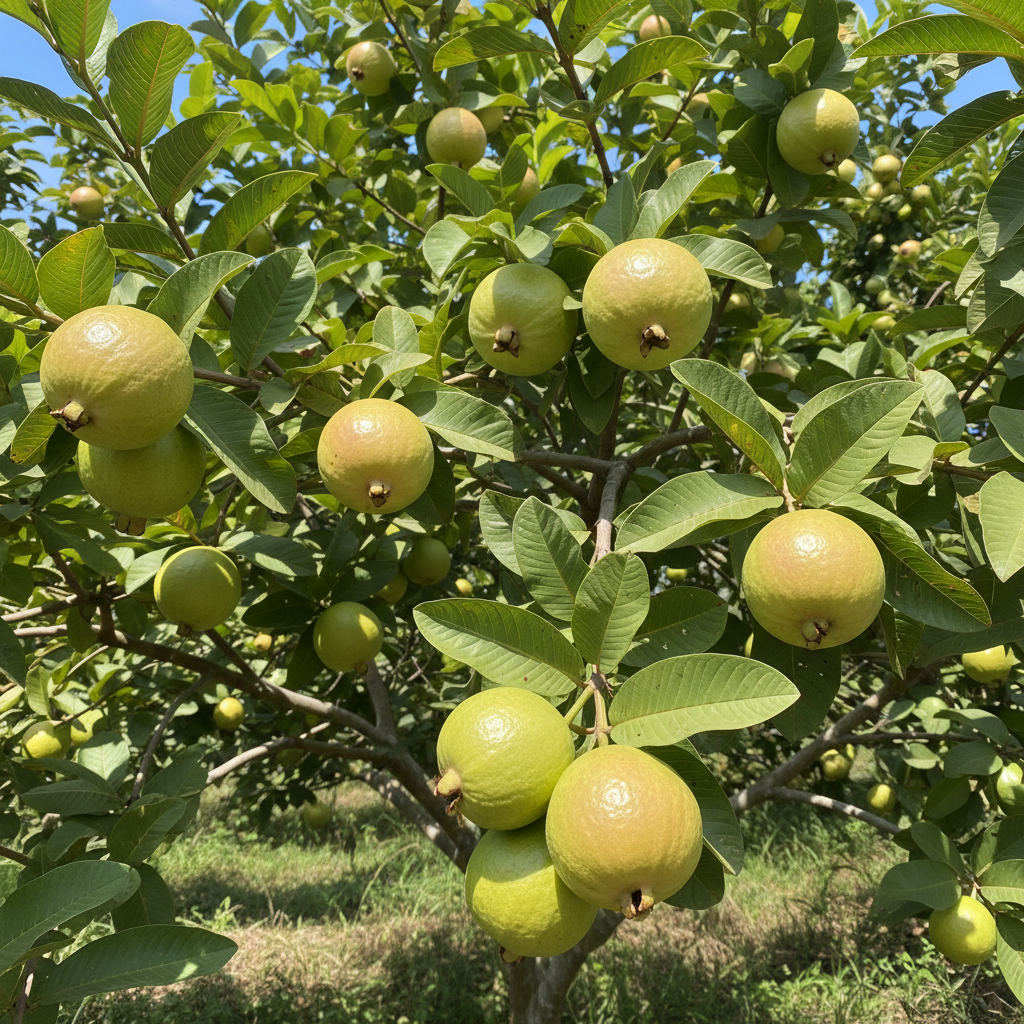
🍈 Guava at a Glance
Guava (Psidium guajava) is a tropical superfruit with green skin and aromatic pink or white flesh, prized for its extraordinary vitamin C content — over 4 times that of oranges. Native to Central America, guava has been cultivated in India for centuries and is deeply embedded in Indian food culture. The Allahabad Safeda variety is considered one of the finest in the world. Known as amrud or peru in Hindi, this humble fruit is a nutritional powerhouse that punches well above its weight, offering more fiber, vitamin C, and potassium per serving than most popular fruits.
✨ Why It’s Special
- 🏆 Vitamin C champion — contains 228 mg per 100g, over 4x more than oranges and among the highest of any fruit
- 🌿 Fiber king — 5.4g of dietary fiber per 100g, one of the highest-fiber fruits available
- 💰 Affordable superfood — widely available and inexpensive in India, making top-tier nutrition accessible to all
- 🍃 Leaves are medicinal — guava leaf tea is used in traditional medicine for digestion, blood sugar, and diarrhea relief
- 🇮🇳 Indian pride — Allahabad (Prayagraj) guavas are world-famous; India is the largest guava producer globally
💪 Health Benefits
- ✅ Supercharges immunity — 228 mg vitamin C per 100g provides 254% of daily needs, far surpassing most fruits
- ✅ Excellent for digestion — high fiber content promotes healthy gut bacteria and regular bowel movements
- ✅ Helps control diabetes — low glycemic index (~25-30) and fiber slow sugar absorption; guava leaf extract improves insulin sensitivity
- ✅ Supports heart health — potassium helps regulate blood pressure; fiber reduces LDL cholesterol levels
- ✅ Promotes healthy skin — vitamin C boosts collagen production; lycopene in pink guava protects against UV damage
- ✅ Aids weight management — low calorie (68 kcal/100g), high fiber, and high water content keep you full longer
- ✅ Improves eyesight — good source of vitamin A and beta-carotene, supporting retinal health
- ✅ Anti-cancer properties — lycopene, quercetin, and vitamin C act as antioxidants that may reduce cancer risk
- ✅ Relieves stress — magnesium in guava helps relax muscles and calm nerves
- ✅ Supports oral health — guava leaves have antimicrobial properties that reduce plaque and treat gum inflammation
| Nutrient |
Amount |
| Calories |
68 kcal |
| Carbohydrates |
14.32 g |
| Dietary Fiber |
5.4 g |
| Natural Sugar |
8.92 g |
| Protein |
2.55 g |
| Fat |
0.95 g |
| Vitamin C |
228.3 mg (254% DV) |
| Potassium |
417 mg |
| Folate |
49 µg |
| Vitamin A |
624 IU |
| Magnesium |
22 mg |
Note: Guava is one of the rare fruits that provides significant protein (2.55g per 100g) alongside its record-breaking vitamin C. Pink guava also contains lycopene (5,204 µg per 100g), a powerful antioxidant typically associated with tomatoes.
🔄 Quick Comparison: Guava vs Orange — Vitamin C Showdown
| Parameter |
🍈 Guava (per 100g) |
🍊 Orange (per 100g) |
| Calories |
68 kcal |
47 kcal |
| Vitamin C |
228.3 mg |
53.2 mg |
| Dietary Fiber |
5.4 g |
2.4 g |
| Potassium |
417 mg |
181 mg |
| Natural Sugar |
8.92 g |
9.35 g |
| Protein |
2.55 g |
0.94 g |
| Vitamin A |
624 IU |
225 IU |
| Best For |
Fiber, vitamin C & protein |
Hydration & citrus flavonoids |
Verdict: Guava dominates with 4.3x more vitamin C, 2.25x more fiber, and nearly 3x the protein. Orange counters with superior hydration, unique hesperidin flavonoids, and wider global availability. For pure vitamin C power, guava is the undisputed champion.
📅 Seasonal Availability
- 🍃 Main season in India: August to December (monsoon and winter guavas are the sweetest)
- ❄️ Winter crop (November–February) is considered superior in sweetness and aroma
- 🌧️ Monsoon crop (July–September) is more abundant but slightly less sweet
- 🌍 Available year-round in tropical regions; imported varieties fill off-season gaps
- 🇮🇳 Major Indian growing regions: Uttar Pradesh (Allahabad/Prayagraj), Maharashtra, Bihar, Madhya Pradesh, and West Bengal
🛒 How to Choose & Store Guava
How to Choose
- 🟢 Look for guavas that are light green to yellowish-green — fully green ones are underripe
- 👃 Ripe guavas have a sweet, musky fragrance you can smell without cutting
- 👆 Should yield slightly to gentle pressure — firm but not rock-hard
- ⚖️ Choose fruits that feel heavy for their size (more pulp and juice)
- ❌ Avoid guavas with bruises, dark spots, or overly soft mushy areas
How to Store
- 🌡️ Room temperature: Unripe guavas ripen in 2–3 days at room temperature
- ❄️ Refrigerator: Ripe guavas keep for 3–5 days in the crisper drawer
- 🧊 Frozen: Cut guava can be frozen for up to 8 months for smoothies
- 💡 To speed ripening, place guava in a brown paper bag with a banana
🥄 How to Use / Consume
Fresh Consumption
- 🍐 Eat raw with a sprinkle of chaat masala, salt, or red chili powder (classic Indian style)
- 🍽️ Slice into fruit salads or eat whole as a filling snack
- 🍃 Keep the skin on — it contains the highest concentration of vitamin C
Beverages
- 🥤 Fresh guava juice or smoothie blended with mint and lime
- 🍵 Guava leaf tea — steep 4–5 leaves in hot water for digestive and blood sugar benefits
- 🥛 Guava milkshake with a dash of cardamom
Cooked & Desserts
- 🍯 Guava jam, jelly, or cheese (a popular preserve in many cultures)
- 🥘 Guava chutney — tangy-sweet condiment perfect with Indian meals
- 🍰 Guava paste (goiabada) served with cheese — a Brazilian-inspired combination
- 🍮 Guava barfi or guava halwa — Indian sweets with a fruity twist
Tips
- 💡 Eat guava with the seeds — they are rich in fiber and omega-3 fatty acids
- 🍃 Don’t discard guava leaves; dry them for herbal tea with proven health benefits
- ⏰ Best eaten between meals as a snack for optimal nutrient absorption
⚠️ Precautions
- ❗ Bloating and gas — high fiber content can cause digestive discomfort if you eat too much too quickly; start with half a guava
- ❗ Stomach upset — excessive vitamin C (from eating many guavas) may cause nausea or diarrhea
- ❗ Seeds difficulty — hard seeds can be challenging for elderly, children, or those with dental issues
- ❗ Unripe guava — raw/unripe guava contains tannins that may cause constipation in some people
- ❗ Pesticide residue — wash thoroughly, especially if eating with skin; choose organic when possible
- ❗ Potassium content — those with kidney disease should monitor intake due to high potassium (417 mg/100g)
- ❗ Allergic reactions — rare but possible; discontinue if you experience itching or swelling
🎉 Fun Facts
- 🌎 Guava originated in Central America and was spread globally by Spanish and Portuguese explorers
- 🇮🇳 India is the world’s largest producer of guava, accounting for over 45% of global production
- 🍃 Guava leaves are used in traditional medicine across Asia, Africa, and South America
- 💎 Called the “apple of the tropics” due to its shape and widespread popularity
- 🧬 A single guava has more vitamin C than 4 oranges combined
- 🌱 Guava trees are remarkably hardy and can grow in poor soil conditions
- 📊 Guava ranks among the top 5 most nutritious fruits according to multiple nutritional databases
- 🏆 The Allahabad Safeda guava won a gold medal at the 1911 Crystal Palace Exhibition in London
- 🍃 In Ayurveda, guava is considered balancing for all three doshas (Vata, Pitta, Kapha) when eaten ripe
- 🐝 Guava flowers are an important source of nectar for bees and pollinators
🍽️ Popular Recipes to Try
- 🥤 Guava Mint Juice — fresh guava blended with mint, lime, and a pinch of black salt
- 🍯 Guava Jam — homemade jam with a perfect tangy-sweet balance
- 🥗 Guava Chaat — sliced guava with chaat masala, lime, and roasted cumin
- 🍰 Guava Cheese Pastry — Brazilian-inspired guava paste with cream cheese
- 🍮 Guava Barfi — Indian sweet made with guava pulp, khoya, and cardamom
- 🥘 Guava Chutney — spicy-sweet condiment perfect with parathas or snacks
- 🥛 Guava Smoothie Bowl — blended guava topped with granola, seeds, and banana slices
Frequently Asked Questions (FAQs)
Q: Is it better to eat guava with or without seeds?
A: Eating guava with seeds is beneficial as they’re rich in fiber, omega-3 fatty acids, and antioxidants. The seeds aid digestion and may help relieve constipation. However, if you have diverticulitis or difficulty chewing, remove the seeds. Most people can safely eat the entire fruit.
Q: Which is healthier - pink or white guava?
A: Both are nutritious, but pink guava has a slight edge. Pink guava contains lycopene (powerful antioxidant) in addition to vitamin C, making it better for heart health and cancer prevention. White guava has more vitamin C. Choose based on availability and personal preference - both are excellent choices.
Q: Can guava help control diabetes?
A: Yes, guava is excellent for diabetics. It has a low glycemic index (around 25-30), high fiber content that slows sugar absorption, and compounds that improve insulin sensitivity. Eating guava regularly may help lower blood sugar levels. Even guava leaf tea is used to manage diabetes.
Q: Why do I feel bloated after eating guava?
A: Guava is very high in fiber (5.4g per 100g). If you’re not used to high-fiber foods, eating too much guava can cause bloating, gas, or stomach discomfort. Start with small portions (half a guava), drink plenty of water, and gradually increase intake as your digestive system adjusts.
Q: Can I eat guava during pregnancy?
A: Yes, guava is highly beneficial during pregnancy. It’s rich in vitamin C (aids iron absorption), folate (prevents neural tube defects), fiber (relieves constipation), and antioxidants. Ensure guavas are washed thoroughly to remove any pesticides or bacteria. Limit to 1-2 guavas per day.
Q: How does guava compare to oranges for vitamin C?
A: Guava contains approximately 228 mg of vitamin C per 100g, while oranges provide about 53 mg per 100g. That makes guava roughly 4.3 times richer in vitamin C. If maximizing vitamin C intake is your goal, guava is the superior choice among common fruits.

Explore More: Fruits • Vegetables • Herbs & Spices • Natural Remedies • Seasonal Picks • Wellness Tips
📚 Sources
- USDA FoodData Central — Guavas, common, raw (NDB #09139)
- Naseer, S. et al. (2018). “The Phytochemistry and Medicinal Value of Psidium guajava (Guava).” Clinical Phytoscience, 4(32).
- National Institute of Nutrition, Hyderabad — Indian Food Composition Tables (2017)
← Back to Fruits